
TheCertified Legacy Collection Curator Course
You know how to organize the materials of a life. This course gives that work educator standing, signifies the value of your judgement, and lets you command more for it.
This course is built on research into how older adults make meaning, why we hold on to some things and let others go, and how an archive carries meaning to an unknown future. It is a practical guide designed to unpack every judgment a heritage curator makes.
WHAT THE COURSE ADDS
To a practice you already have
You have organized the photographs, built the finding aid, sat with the family that did not know where to begin. None of that changes here. What changes is the moment you are practicing in, and what you can now say about your work in it.
Knowledge
Archival decision-making you can charge for. The discipline of significance — how to weigh a life's materials against a standard rather than a feeling, and place each one where it belongs.
Standing
A certification the room recognizes. A published standard your work can be measured against, and a signature behind every archive you produce.
Practice
Assets that travel with you. A working language for the room where a family arrives having already tried an app, and an architecture that keeps a collection legible to a descendant fifty years on.
What the Course Teaches
How a later life makes meaning.
The developmental science of the last decades — why certain materials pull and others repel, why a long pause is thought and not failure, why this reckoning is among the most consequential acts of a person's later years. Geragogy: learning, and teaching, at the far end of a life.
The psychology of keeping and releasing.
Why releasing an object is a curatorial act and not a loss, and how to conduct it so a Senior Fellow feels lighter rather than bereaved. The discipline of weighing, and the language that lets a hard decision feel like a considered one.
How an archive conveys meaning.
What makes a record legible to a stranger decades on — provenance, significance, structure — and how the choices made today decide whether a life reads as evidence or scatters into a pile.
What the synthetic age changes.
Why a record made by human hands means something a generated one cannot, now that the two can look alike — and a clear, grounded way to explain that worth to a family deciding what it's for.
10
MODULES
1.0
CEU EQUIVALENT
6
LEARNING LAYERS
HOW YOU LEARN
Six Layers of learning. Every module.
Each chapter moves from reading to listening to seeing to building. The sixth layer is the one you keep: an instrument that goes straight into your practice.
LAYER 1
The Handbook Chapter
The foundational text. Scholarly, precise, the source of record every other layer aligns to.
LAYER 3
The Deck
The chapter distilled to its key concepts and its logic as a whole. The orientation before you enter the detail.
LAYER 2
The Thought Walker
A thirty-minute audio episode made for a time you spend walking. Not a summary — a narrative encounter with the chapter's ideas.
LAYER 4
The Overview
A concise visual orientation, connecting each concept to the practice it serves at the table.
LAYER 5
The Heuristic
The whole chapter rendered as one coherent figure, its structure visible at a glance.
LAYER 6
The Working Tool
The instrument you keep — a template, a criteria frame, a manifest component — carried straight into your practice and the work you submit to certify.
THE CURRICULUM
Ten modules. One arc.
The course moves the way the work itself does — from the condition that makes it urgent, through the discipline and instruments that govern it, to the ceremony that places a finished life in its owner's hands. You learn the shape by moving through it.
MODULE 1
The Horizon
The condition that makes this work urgent: human and machine-made accounts of a life now sit side by side in the same archive, indistinguishable, and the lives with the thinnest record are the ones a model invents most freely. You learn to see the problem precisely, and to say what a human curator supplies that nothing else can.
MODULE 2
The Lineage
Two older traditions meet in the curator's work: the listener who sits with a person and takes down a life as it is told, and the archivist whose signature is what lets that record stand, later, as evidence. You learn how this certification draws both together, and why your own signature now carries the weight an institution once did.
MODULE 3
The Modern Elder
What an older adult's mind is actually doing in late life, drawn from developmental research the field has never required of itself. You learn why crystallized judgment is at its height in the very years a culture writes off, and how to read a room no one else in the Fellow's life can read.
How the certification becomes a working life. You learn the ceremony that closes an engagement and places a finished life in the record, and the Guild you enter as the work begins — the community, the standing, and the public voice that carry a certification into the world.
MODULE 4
The Materials of Life
Long before the word existed, a grandmother curated the shoebox on the high shelf, under conditions her era supplied: scarcity, attestation, deliberation. You learn what those conditions did, why they ended at the turn of the millennium, and why the discipline they once enforced now needs a trained hand.
MODULE 5
The Discipline
MODULE 6
The Engagement
MODULE 7
The Weigh and the Winnow
MODULE 8
The Pyramid
MODULE 9
The Architecture
MODULE 10
The Guild
The single standard beneath the certification, in three parts: who does the work, how its chain of custody is kept, and who finally owns what is made. You learn to hold them as one posture rather than three rules, and to draw the line where your tools stop and the curatorial act begins.
The form the work is conducted inside: a six-month engagement that runs from first meeting to closing ceremony, with a defined sequence at every stage. You learn its four opening operations — Survey, Weigh, Winnow, Inscribe — and why a form that supplies your next move means you never have to improvise.
How to weigh significance when a Fellow is ready to start sorting and shouldn't yet, because significance is not what an item means to its holder but what it carries to people the holder will never meet. You learn the figure of the Stranger, and the published criteria you bring to every table.
The instrument that replaces the flat list with a weighed shape: Trove at the apex, Hold in the middle, Release at the base, the apex kept deliberately small. You learn to build it with a Fellow, and to teach her the form so she can use it again on a box a grandchild carries down years from now.
What lets a curated collection still open in a century: the preservation standards institutions use for permanent records, and Sondage's own separation of human material from machine-made. You learn to build so a descendant with no training and no subscription can still read what you made.
THE INSTRUMENT AT THE CENTER
How Weigh a Life, Not Just Sort It
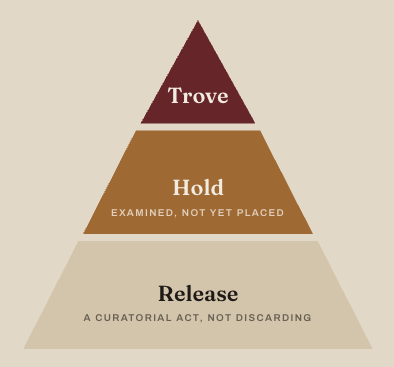
Every good curator already does this — sensing which materials carry the weight of a life and which can be let go. What the course adds is a structure and shared language: Trove, Hold, Release. You learn the research behind “winnowing” and the release of material “with honor.” You learn how to teach this in practice. The result is a Senior Fellow who leaves more reflective, knowledgeable, and content knowing not only what was kept, but why.
TROVE · HOLD · RELEASE
THE CLOSE
RITUAL: You learn to lead the ceremony this work asks for.
In this course you learn why ritual and ceremony matter for older adults, and you gain the tools to lead them. This is not ornament added at the end. For a person in late life, being formally witnessed is part of how meaning is made — accomplishment that no one marks can come to feel as though it never happened. The anthropologist Barbara Myerhoff named the remedy a definitional ceremony: an occasion where people gather to recognize a person and make their standing real. That is why the curriculum gives ritual as much weight as method.
Two rituals run through the work. The first is quiet and constant — the ritual of keeping and releasing, conducted so that each thing set down is set down with intention, and letting go reads as a considered act rather than a loss. The second is the close, the ceremony Sondage calls the Witnessing: every engagement ends in one, designed across its months and convened at its end, the finished archive read aloud, tier by tier, to the people the Fellow has chosen — each there for what they alone will recognize.
You name the close. Someone has always been needed to mark the threshold, and almost no other practitioner in a family's life is positioned to hold it. The course is where you learn to.
WHAT YOU WILL BUILD
Four assets you walk out with
The course does not end in a designation alone. It ends in a body of work that is unmistakably yours — and ready for your first Senior Fellow.
HOW FAMILIES FIND YOU
Your Registry Page
The public profile under your own name, formatted to governance standard, where a family — and the estate attorneys, genealogical societies, and university archives beginning to ask for a certified practitioner — find you and decide you are the one they have been looking for. It points the clients you already have to a standards body that signs what you already do. A lead source, and it is yours.
WHO YOU PRACTICE AMONG
Your Guild Standing
Membership in the Sondage Guild — the working community of certified practitioners holding one standard, entered under your own name and vouched for by peers. With it comes the standing invitation of the First Rule of Sondage: to write, post, speak, and teach about the work in public, in your own voice, across venues. It is how your judgment reaches past a single engagement — and how a certification, and a reputation, travel.
WHAT YOU PUT YOUR NAME TO
Your Season Manifest
The instrument you close and sign at the end of every engagement you certify — the record that turns a curated Trove into a Sondage-Certified Primary Source. You learn to build a family's archive to the standards institutions use for permanent records: OAIS, the model that came out of the world's space agencies; OCFL, the layout that keeps an archive openable with no platform and no training; and the GIP, Sondage's own separation of human and machine-made material. No app can produce it, and no one without the certification can sign it. You leave with your own Manifest built and ready.
WHAT ONLY YOU CAN OFFER
Your Curatorial Criteria
Your own statement of how you weigh — the principles by which you decide what a life carries forward, drawn from the discipline the course teaches: Weigh, Winnow, the Significance Pyramid, the Stranger at the table. You are not publishing a standard; you are interpreting the Sondage discipline and extending it in your own voice. Posted on your Registry page, it is what lets a family choose you on the strength of how you think — the one thing in the market that cannot be copied, because it is yours.
YOUR PATH TO CERTIFICATION
One submission. No busywork.
Certification is earned through a single, practical submission at the end of the course, built in Notion, organized around four parts. There are no scattered assignments along the way. Each part meets a certification requirement and becomes an instrument of your own practice — something you carry into your first Seminar on the Trove. The assessments are scaffolded: a fillable template and a worked example, so you never start from a blank page.