
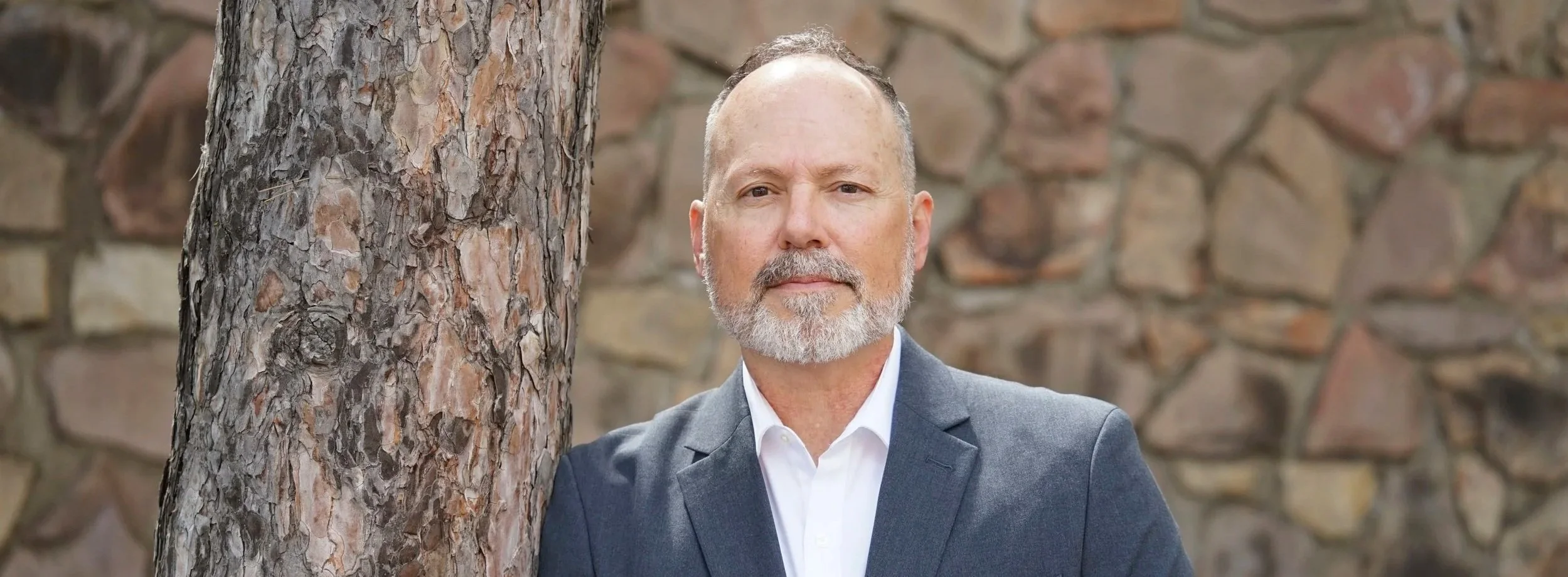
Stephen Mucher, Founder of Sondage
A lifelong recorder of voices
Stephen Mucher, Ph.D., is a social historian, geragogist, and the founder of Sondage, a standards and governance framework for human-conducted life history inquiry and preservation. His career spans more than twenty-five years in history and liberal arts education in the U.S. and abroad, including teaching and administrative roles at Bard College, UC Berkeley, and UCLA, where he most recently served as a dean and directed the Osher Lifelong Learning Institute (OLLI @ UCLA). His commentary has appeared in The Washington Post, the Los Angeles Times, and Inside Higher Ed, and on NPR's All Things Considered. Mucher holds a doctorate from the University of Michigan and has recorded voices in more than two dozen countries on five continents. He founded Sondage in Berkeley, California, in 2025 and is a Visiting Fellow at the Digital Life Initiative at Cornell Tech in New York City.
Formation as a Historian
Mucher grew up in the foothills of Appalachia and began recording voices as a boy, using a Realistic CTR-80 recorder from Radio Shack and external microphone gifted by a family friend. He was drawn to communities that still took elder wisdom seriously, and he set out to document their history in spoken word and song. In graduate school this informal practice gained disciplinary grounding as he turned to institutional archives and the use of primary sources in historical interpretation. His doctoral work examined the development of universal public education in the late-nineteenth-century United States, drawing on hundreds of letters, teacher observations, and school records he located in archives across the Midwest.
Geragogy and the Osher Lifelong Learning Institute at UCLA
Mucher has taught students of all ages and backgrounds, but he eventually gravitated to geragogy, the underexplored study of how adults in later life learn and make meaning. That interest led him to direct the Osher Lifelong Learning Institute at UCLA, where he worked alongside accomplished women and men in their seventies and eighties, and later to teach for OLLIs at Duke University, Dartmouth College, Johns Hopkins University, and Carnegie Mellon University. This work showed him that later-life learners retain a strong desire to review their life stories, and bring what the psychologist Raymond Cattell called crystallized intelligence into the classroom and their community.
Through his work in geragogy and the cognitive science of history learning, Mucher arrived at a conviction: that later-life review is a distinct developmental phase, that the desire for it and for intergenerational understanding is universal, and that until recently it was practiced widely, most evident through oral, artistic, and written rituals in traditional societies. Sondage was founded in part to push back against narratives that disregard the contributions and wisdom of older adults, and to promote new rituals for reflection, documentation, and family exchange.
Documenting the Pacific Crest Trail
In 2025 Mucher left UCLA to hike the Pacific Crest Trail from the Mexican border to Canada, 2,655 miles over five months. He planned simply to walk and listen, enacting a form of life review away from modern technology. Along the way he met a community of thru-hikers who inspired him to pick up the microphone again, this time with one provocative driving question: Is the trail an extension of the life you live, or a break from it? Over the remainder of the hike he recorded more than 100 answers. These are not exactly oral histories, but rather a captured moment of reflection from an individual looking for meaning. The project earned him the trail name "Verbatim" and served as a laboratory for what became Sondage.
The Founding of Sondage
After the trail, Mucher came to see that what he had found there — unhurried conversation between two people, recorded on purpose for future listeners — differs profoundly from the commercial products now applying AI to life history preservation. Sondage's standards of practice are in large part a response to what Mucher calls auto-autobiography: the life story that appears to write itself. These apps use algorithms to extract a consumer’s reminiscences and generate that content into a life narrative, with little accountabilty or transparency. He also saw genealogy and family history, fields that have long valued research as an act of personal agency and a labor of discovery, grow increasingly reliant on AI tools.
Sondage certifies practitioners and outlines the conditions under which a human-conducted life history archive qualifies as a primary source. It serves as a response to the Authentication Horizon, the point past which authentic and synthetic biographical records become formally indistinguishable in the archive. The platform maintains a Registry of certified independent practitioners accountable to three Foundational Commitments governing every Sondage Season. They are Human Authorship, Embodied Provenance, and Non-Custodial Sovereignty. His current essays appear in The Sondage Review.
At Cornell Tech, Mucher is comparing traditional historical method to the practices behind commercial AI heritage products and auto-autobiography, which he calls Automated Biographical Elicitation and Re-call (ABER).
He lives in Seattle and Berkeley.
——————
This page is 100% human-written